
AI-enabled crypto scams rose approximately 500% year-over-year in 2025. That figure, from TRM Labs, sits alongside $158 billion in illicit crypto volume for the same year. Meanwhile, hundreds of "signal" services flood Telegram, Twitter, and Discord, promising 500% returns and posting only winning trades. Most are scams, survivorship bias, or both.
The criteria that separate legitimate AI from noise are not complicated. They just require knowing what to look for.
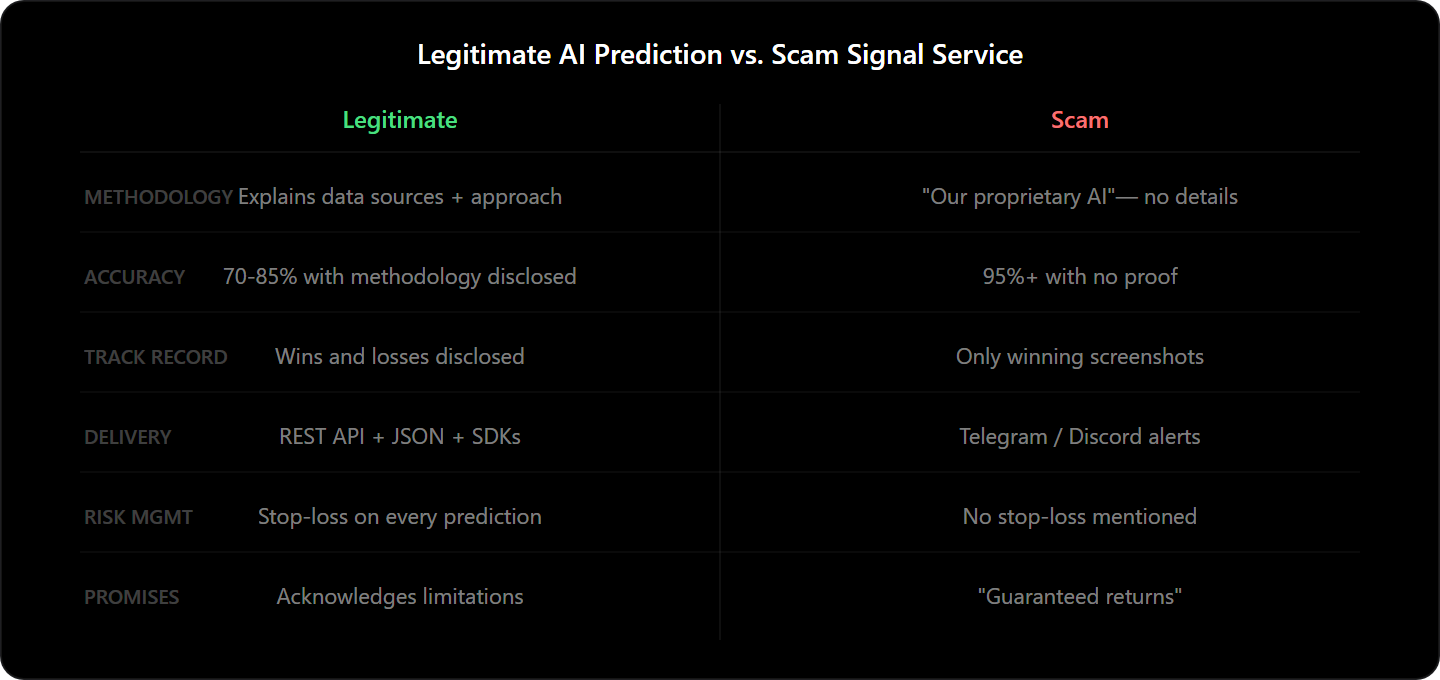
Black boxes don't deserve your money.
If a service says "our proprietary AI predicts crypto prices" and stops there, walk away.
Legitimate prediction services can explain what data they use — price action, volume, on-chain metrics, sentiment — and what type of models they employ. Not the source code, but the general approach. They can describe how they validate accuracy: backtesting methodology, dataset composition, time period covered.
They don't need to open-source their models. But they need to be transparent enough that you can form a reasonable judgment about whether the approach is sound.
95% accuracy is a lie.
Any service claiming 90%+ prediction accuracy on crypto markets is either lying, measuring something trivial, or hasn't been tested over a meaningful time period.
Most quant funds operate in the 60-70% range and consider that good. Institutional-grade edge sits at 70-80%. Anything above 85% is possible in specific conditions — long-term, high-cap assets — but not sustainable across all assets and timeframes.
The definition of "accuracy" matters enormously. Direction only? Price target within X%? A model that's 95% accurate over 10 trades is meaningless. Show me 1,000+ predictions across multiple market conditions, including bear markets, on clearly specified assets.
If you can't see the losses, there is no track record.
A legitimate service shows historical predictions — not just the winners.
Timestamped historical predictions, ideally independently verified, are the baseline. Win rate and loss rate disclosed together, average return per trade, maximum drawdown during adverse periods.
If a service only shows screenshots of winning trades, you're looking at survivorship bias — not performance.
"Guaranteed returns" is how fraud sounds.
Crypto trading is inherently risky. Any service using words like "guaranteed," "risk-free," "always profitable," or "never lose" is violating basic truth — and likely securities regulations.
Legitimate services include disclaimers not as legal theater, but as genuine warnings. Predictions can be wrong. Markets can crash. Stop-losses can be blown through in flash crashes.
Telegram alerts are not infrastructure.
Serious prediction services provide an API. They deliver structured data you can integrate into your own systems — not messages you have to act on manually.
Structured JSON responses with entry, stop-loss, take-profit, and confidence data are the minimum. Historical prediction data for backtesting and documented endpoints are standard. If the only delivery mechanism is Telegram messages, Discord alerts, or email newsletters with "BUY NOW" subject lines, the service is designed for emotional impulse, not systematic trading.
What to look for instead.
A credible service explains its methodology — not source code, but the general approach, data sources, and validation process. It makes realistic accuracy claims, typically 60-85%, with clear definitions of what "accuracy" means.
Its track record is verifiable. Timestamped predictions, wins and losses, across multiple market conditions. Data delivery is structured: an API with documented endpoints, not Telegram messages.
Every signal includes a stop-loss level. The service acknowledges what it cannot predict and when its models underperform. And it offers a free tier for evaluation — because if the team won't let you test the product, they don't trust their own predictions.
Any service that passes all seven criteria is worth a closer look. Any service that fails more than two probably isn't.
In a market where scam volume grew 500% in a single year, the most valuable skill isn't picking signals — it's recognizing which ones were never real.
If you want to see how these principles work in practice, Pearlixa offers a free tier to evaluate.
This article is for educational purposes only and does not constitute financial or investment advice. Cryptocurrency trading involves substantial risk of loss.