
A strategy that wins 60% of the time should be profitable. In practice, many traders running strategies with better-than-average win rates still lose money. The math should work. It does not.
The most common reason is not the entry. It is the stop-loss.
Specifically: it is placing stop-losses at fixed percentage levels instead of at market structure levels. This single mistake converts a mathematically sound strategy into one that bleeds out on normal market noise.
What a fixed percentage stop actually does.
The most common retail approach: set a stop-loss at 5% below entry, or 8%, or 10%. It feels systematic. It is not.
A fixed percentage has no relationship to how the asset actually moves. Bitcoin does not know your stop is at 5%. The market does not adjust its volatility to avoid triggering your rules.
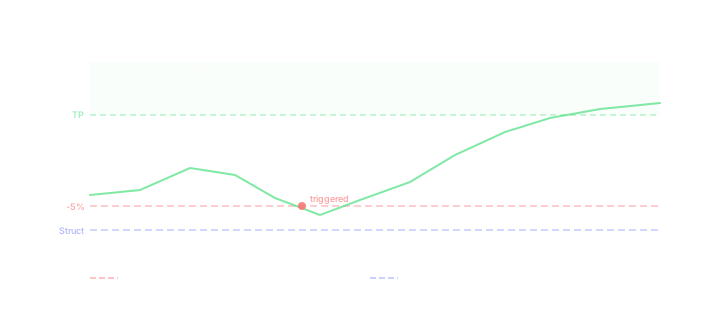
What fixed percentage stops do in practice: they get triggered by normal price fluctuation before the thesis has a chance to play out, then the asset recovers and moves in the originally expected direction — without you.
This is called getting "stopped out" of a winning trade. It happens constantly, and it is not bad luck. It is a structural consequence of placing stops where the math is convenient rather than where the market provides a meaningful signal.
What a market structure stop actually does.
A market structure stop-loss is placed at the level where the trade thesis is specifically wrong — not where the loss reaches a round number.
For a long trade, the thesis is that price will move higher from the entry. That thesis has a specific invalidation point: the support level that was holding, the prior swing low, the level that defined the range. If price breaks below that level with conviction, the expected move is not happening. The information content of that break is: this trade is wrong.
A stop placed at that level does two things a fixed percentage stop cannot:
It survives normal volatility. Price can wick below a round percentage level and recover. It is much less likely to wick through a well-defined support level and recover in the same way — because that level is where other market participants are also making decisions.
It gives the trade room to develop. Markets do not move in straight lines. A tight fixed percentage stop eliminates trades before the setup has time to work. A market structure stop holds until the market itself tells you the thesis is wrong.
The math that makes this concrete.
Take a long entry on Ethereum at $3,200.
Fixed percentage stop at 5%: Stop at $3,040. Risk per ETH: $160.
Market structure stop at the prior swing low: Stop at $3,050. Risk per ETH: $150.
In this case they are close. But here is what diverges: the fixed percentage stop of $3,040 may sit in the middle of a range where normal price action fluctuates. The $3,050 swing low is a level that was actually tested and held.
Now suppose there is a wick to $3,045 before Ethereum recovers to $3,480. The fixed percentage stop triggers. The market structure stop holds. Same entry. Same eventual outcome. One trader is out with a loss; the other reaches the take-profit target.
This is not a hypothetical. It happens on every liquid asset, every trading session, in every direction.
Why traders use fixed percentages anyway.
Fixed percentage stops are psychologically easier. They create the feeling of control through precision. "I will never lose more than 5% on any trade" sounds like risk management. It produces the correct emotion: a sense of defined exposure.
The problem is that the feeling of control and actual risk management are different things.
Actual risk management is about placing stops at levels that are meaningful to the market — where the trade thesis breaks down — and then sizing the position to ensure that stop-loss, if triggered, represents an acceptable loss in dollar terms.
The sequence is: identify market structure stop → calculate distance from entry → size position so that distance equals acceptable risk. Not: decide on a percentage → place stop there → hope the market respects it.
How to find the market structure stop.
For a long trade, the stop-loss belongs below the most recent significant support that is relevant to the trade thesis. Specifically:
The prior swing low that preceded the move you are trying to capture. If price breaks back below that low, the swing did not materialize as expected.
The support level that defined the consolidation zone the breakout is emerging from. If price re-enters the consolidation, the breakout has failed.
The high-volume node below price where significant buying previously occurred. If price falls through that level on volume, the buyers who defined it have been overwhelmed.
What makes these levels significant: other market participants see them too. They are not arbitrary. They are points where supply and demand previously interacted in a way that left a mark on the chart.
The complete picture: stop-loss and position size work together.
A market structure stop-loss has a different distance from entry on every trade. Sometimes it is 3%. Sometimes it is 9%. The distance is determined by the market, not by a rule.
This means position sizing must adjust to keep risk constant in dollar terms.
If your acceptable risk per trade is $200 and the market structure stop is $150 away on Bitcoin: your position size is 0.00133 BTC. If the stop is $300 away: your position size is 0.000667 BTC. The dollar risk stays the same. The position size changes.
Traders who use fixed percentage stops often have fixed position sizes too. Both inputs are wrong. The result is inconsistent risk that compounds losses on wide-stop trades and wastes edge on tight-stop trades.
A complete quant signal includes the stop-loss for a reason.
When a quant signal provides a stop-loss level, it is not providing a suggestion. It is providing the market structure invalidation point — the specific level derived from price history and volatility analysis where the expected move breaks down.
That level is not interchangeable with a fixed percentage you prefer. It reflects the actual structure of the asset at the time of the signal.
Using the signal's entry and take-profit while substituting your own stop-loss changes the entire trade. The risk/reward ratio is now yours, not the signal's. The expected value calculation the signal represents no longer applies.
The stop-loss is not the uncomfortable part of the trade setup. It is the part that defines everything else.
Cryptocurrency trading involves substantial risk of loss. This content is for educational purposes only and does not constitute financial or investment advice.