
"BUY BTC."
That is a signal. It tells you one thing: direction. It does not tell you where to enter, how much to risk, where you are wrong, or where to take profit. It gives you a destination with no map and no fuel gauge.
Most crypto signal services stop here. The reason is not technical — generating a direction is the easiest part of any quant model. The reason is that everything after the direction requires committing to specifics that can be checked against reality.
A trade setup is different. It contains everything you need to act on the signal systematically: entry price, stop-loss level, take-profit target, a measure of confidence, and an implied risk/reward ratio. Remove any one of those five elements and you have an incomplete picture.
This is not a subtle distinction. It determines whether you can manage risk before you enter — or whether you figure it out while the position is already open and moving against you.
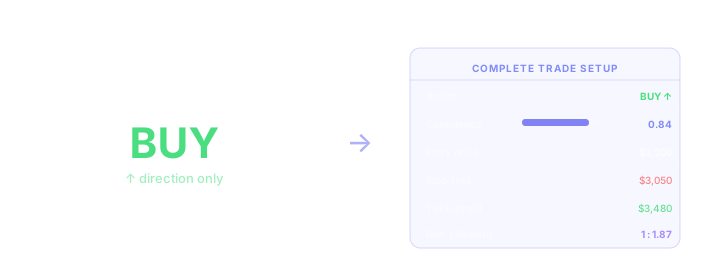
What a signal is.
A signal tells you directional intent: buy, sell, or hold. In its most basic form, it is a binary output — the quant model assessed the available data and concluded that price is more likely to go up than down.
That conclusion has value. It is more than a coin flip if the underlying model is well-built. But it does not tell you how to act on it.
Consider two traders who both receive a BUY signal for Ethereum at $3,200. The first trader buys $5,000 worth at market and decides to watch it. The second trader does not trade at all because they have no framework for determining where they are wrong or how much to risk.
Neither of them can act well on the signal alone. One acts without a plan. The other cannot act at all.
What a trade setup requires.
A complete trade setup has five elements. Each one serves a specific function that the others cannot replace.
Entry price. The price level at which the trade makes sense given the quant model's analysis. This is not always the current market price. Sometimes the model identifies an optimal entry that requires waiting for a pullback or a breakout confirmation. Trading at a different price changes the risk/reward ratio of the entire setup.
Stop-loss level. The price at which the thesis is invalidated. If price reaches this level, the expected move is not happening, and continuing to hold adds risk without adding information. The stop-loss is not where you hope the trade won't go. It is the specific level where the quant model's logic breaks down.
Take-profit target. The price at which the expected move has largely played out. Without a predefined exit, winning trades frequently turn into losing ones. Most traders are disciplined enough to enter a position. Very few are disciplined enough to exit one when it is profitable.
Confidence score. A calibrated probability expressing how certain the quant model is about the signal. This is what determines position size. An 85% confidence prediction warrants a different allocation than a 62% confidence prediction — not because one is "better" than the other in some abstract sense, but because the expected outcomes are mathematically different.
Implied risk/reward ratio. Calculated from entry, stop-loss, and take-profit: the ratio of potential gain to potential loss. A setup with a 3:1 reward-to-risk ratio is worth trading even at a 50% win rate. A setup with a 0.8:1 ratio requires an implausibly high win rate to be profitable over time.
The math that only works with all five elements.
Take a BUY prediction for Ethereum with these parameters:
- Entry: $3,200
- Stop-loss: $3,050
- Take-profit: $3,480
- Confidence: 0.78
Risk per ETH: $150 (entry minus stop-loss) Reward per ETH: $280 (take-profit minus entry) Risk/reward ratio: 1.87:1 Confidence: 78%
From these four numbers you can calculate expected value: multiply the confidence by the reward, subtract (1 minus confidence) multiplied by the risk.
(0.78 × $280) − (0.22 × $150) = $218.40 − $33.00 = $185.40 positive expected value per ETH traded
You can now make a rational decision about whether this trade meets your criteria — before you enter, before you have a position affecting your judgment.
Remove the stop-loss and you cannot calculate risk. Remove the take-profit and you cannot calculate reward. Remove the confidence score and you cannot weight the probabilities. Remove the entry price and the risk/reward ratio changes with every tick.
The signal says BUY. The setup says whether BUY is worth acting on, and exactly how.
Why most services stop at direction.
Generating a direction is testable in the most basic sense: was price higher or lower a day later? Most signal providers measure themselves this way because it is the metric most favorable to them.
A stop-loss level can be hit even when the eventual direction was correct. Price can dip through the stop, then reverse and reach the target — leaving a trader with a loss on a technically "correct" signal. Services that provide stop-loss levels are exposed to this kind of outcome in a way that services providing only directions are not.
A take-profit level creates accountability for the magnitude of the move, not just the direction. An entry price creates accountability for timing and risk/reward, not just outcome.
Every additional element in a trade setup is another dimension along which the prediction can be right or wrong. Services that stop at direction minimize the dimensions along which they can be evaluated.
That minimization is useful for the service. It is not useful for you.
How to turn a signal into a setup if one isn't provided.
If you are working with a signal that provides direction but not the full setup, you can build one — but understand that each element you add manually reintroduces the judgment and subjectivity the signal was supposed to remove.
For entry price: the current market price is the default, but check for nearby support (for buys) or resistance (for sells) that would offer a better entry with lower risk.
For stop-loss: identify the nearest technically significant level below the entry (for buys) where the bullish thesis would be invalidated. This is not a fixed percentage — it is a market structure level. For volatile assets, stops placed at fixed percentages get triggered by normal fluctuations.
For take-profit: identify the nearest resistance level above entry (for buys) that represents a realistic target given recent price structure.
For confidence: if no score is provided, you have no calibrated probability. You can substitute with your own assessment, but acknowledge that this is discretionary judgment, not systematic inference.
The complete setup is harder to generate than the signal. That is why most services do not include it. That is also why it is worth finding one that does.
A signal tells you where to go. A setup tells you whether it is worth the trip, how much fuel to take, and exactly when to turn around.
Cryptocurrency trading involves substantial risk of loss. This content is for educational purposes only and does not constitute financial or investment advice.