Your risk system covers everything. Except the part that moves.
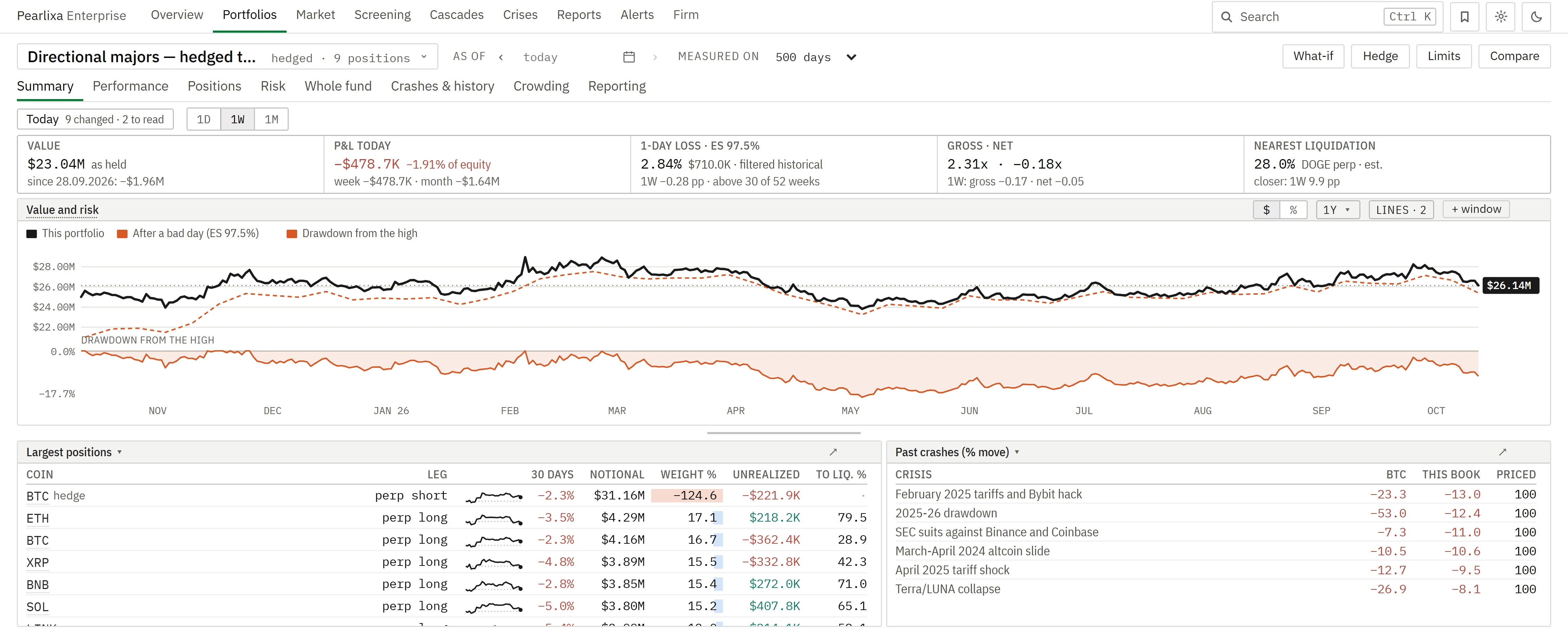
What the crypto portfolio can lose tomorrow, how it came through every crash since 2013, and which asset is carrying the risk.
One product, read differently by every kind of fund.
One-day loss
What a bad day costs the portfolio at 97.5%, and how many weeks of the past year were above it.
Start with what you already have.
Portfolios are onboarded from the files a fund already produces, such as exchange and PMS exports or spreadsheets. Each portfolio is validated and confirmed with the fund before it is analysed.
Crypto is the smallest line in the portfolio. It can carry a third of the risk.
Most funds measure the crypto sleeve with risk tools built for traditional markets, at correlations that do not hold in a crash.
Pearlixa measures the traditional portfolio and the crypto sleeve together, and reports the sleeve's share of the fund's risk.
In a market crash, the crypto sleeve's share of the risk rises to 43%.
Everything a fund's risk system does, built for how crypto trades.
Risk
How much the portfolio can lose, and where the risk sits.
Stress testing and liquidity
What a crash would cost, and what it would cost to exit.
Scenarios
What a proposed change would do to the portfolio, before it is made.
Every asset, measured before it enters the portfolio.
Assets screened every day on tail, drawdown, liquidity and crowding. Each opens to its own risk page, and to what it would add to the portfolio.
The same figures, ready for the committee, the investors and the supervisor.
Morning pack, committee report and investor letter, placed in the firm's own Word and PowerPoint templates. Supervisor files are included: the AIFMD Annex IV risk figures and the ESMA liquidity stress test.
Insights
All insightsIf the US stopped building data centers, where would it show up?
US data center building runs at $85 billion a year as other construction shrinks. Where a stop would hit, and why its GDP effect depends on what you count.
The CFTC paused compute futures. The filing shows what it's weighing.
CME's GPU futures won't list on October 5. The CFTC extended its review to November 9. The filing shows how the contracts settle and what is still unproven.
Compute gets a price. Which one isn't settled yet.
Silicon Data publishes two H100 prices, 2.8x apart, and the CME compute futures spec does not say which one settles the contract. Why the difference matters.